

Far From Humans
A geography of seams
Which passages remain open? Who depends on them? The Atlas brings together routes, corrections and disagreements between maps.
Read the survey
Nadir-Theta continuity fragment
A continuity describes known passages and their dependencies. Read a survey, then compare it with the field corrections.
Read the map as text ↓Reading tools ·
Tab into the map, arrow keys to navigate elements, Enter to select. Escape closes details. The wheel scrolls the page; enable Move to drag the map.
visible elements
Selection details
Back to the mapRead the map as text
Two surveys, four differences. Neither edition automatically determines the truth.
Reference edition
A cautious structural reading of the known network.
NT-S3 is classified as dead. NT-S5 does not appear in this survey.
Nodes in the edition
- Nadir-Theta system · confirmed. Thren is a planet in the Nadir-Theta system. Orphée is a MAM locally associated with Thren. This local context creates no continuity node or passage.
- NT-B1 Survey Blank blank zone · unknown.
- NT-F1 Seam End seam end · disputed.
- NT-F2 Seam End seam end · probable.
- NT-J1 Junction junction · confirmed.
- NT-J2 Junction junction · probable.
Seams in the edition
-
NT-S1 · Nadir-Theta ↔ NT-J1 Junction
stable · confirmed · travel in both directions.
Communications available along this seam
-
NT-S2 · NT-J1 Junction ↔ NT-J2 Junction
regulated · confirmed · travel in both directions.
Communications filtered along this regulated seam. Ships, messages and transactions share the same control along this seam.
-
NT-S3 · NT-J2 Junction ↔ NT-F1 Seam End
dead · confirmed · travel in both directions.
Silence in both directions
-
NT-S4 · NT-J1 Junction ↔ NT-F2 Seam End
closed · probable · travel in both directions.
Silence in both directions
Field corrections
Corrections from an unnamed collective field provenance.
NT-S3 is described as broken and its reliability disputed. NT-S5 appears as intermittent and probable.
Nodes in the edition
- Nadir-Theta system · confirmed. Thren is a planet in the Nadir-Theta system. Orphée is a MAM locally associated with Thren. This local context creates no continuity node or passage.
- NT-B1 Survey Blank blank zone · unknown. Documentary edge redrawn; no physical or topological change.
- NT-F1 Seam End seam end · disputed.
- NT-F2 Seam End seam end · probable.
- NT-J1 Junction junction · confirmed.
- NT-J2 Junction junction · probable.
Seams in the edition
-
NT-S1 · Nadir-Theta ↔ NT-J1 Junction
stable · confirmed · travel in both directions.
Communications available along this seam
-
NT-S2 · NT-J1 Junction ↔ NT-J2 Junction
regulated · confirmed · travel in both directions.
Communications filtered along this regulated seam. Ships, messages and transactions share the same control along this seam.
-
NT-S3 · NT-J2 Junction ↔ NT-F1 Seam End
broken · disputed · travel in both directions.
Silence in both directions
Status changed in this edition · Reliability changed in this edition
-
NT-S4 · NT-J1 Junction ↔ NT-F2 Seam End
closed · probable · travel in both directions.
Silence in both directions
-
NT-S5 · NT-J2 Junction ↔ NT-B1 Survey Blank
intermittent · probable · travel in both directions.
Communications limited to the same windows as passage
Addition specific to this edition
What changes between surveys
- NT-B1 — Documentary edge redrawn; no physical or topological change.
- NT-S3 — Status changed in this edition dead → broken.
- NT-S3 — Reliability changed in this edition confirmed → disputed.
- NT-S5 — Addition specific to this edition
Two neighbouring systems may be separated forever. Two places whose true distance no one knows may depend on the same FTLA seam. To travel, you need to know which passages still hold.
The Atlas brings together routes, dependencies and corrections. Accounts sometimes contradict each other. A map may serve propaganda; it may also be out of date because the universe has changed since its last revision.
Reading a map that does not measure distance
In the Atlas, graphic proximity never implies physical proximity. It reveals dependencies, passages and contradictory versions of the same network.
- A node is not placed near another because the two are close in space, but because a known route makes them dependent on one another.
- A stable seam remains continuously usable. A regulated seam may filter passage. An intermittent seam exists only through limited windows.
- Messages, transactions and news follow exactly the same seams as ships. A closed seam also imposes silence.
- Every edition has an author, an age and an interest. A correction may be more accurate than an official map, or merely more recent.
Thren
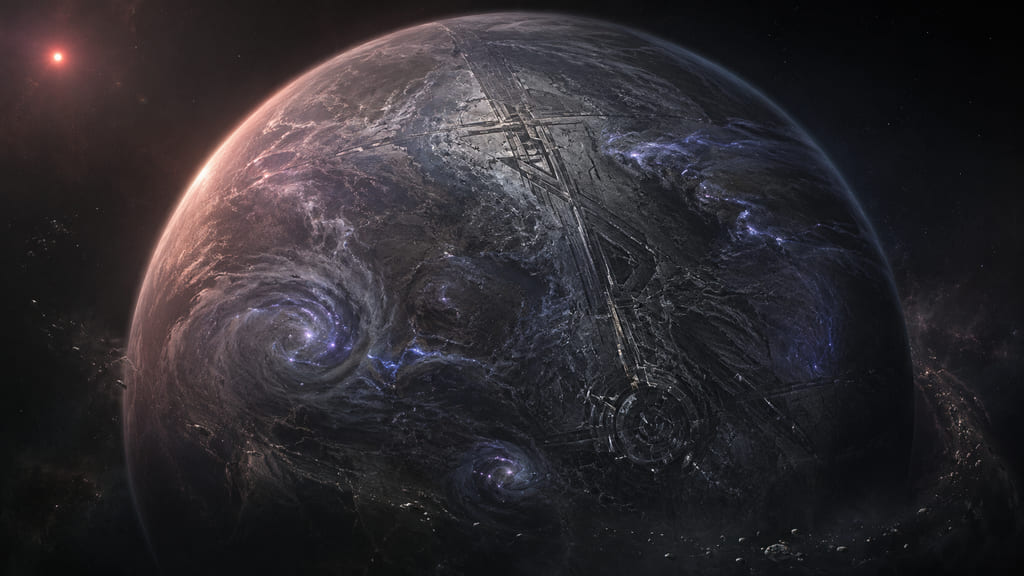
In the Nadir-Theta system, Thren bears continental sutures and spore plains. The remains of infrastructure have become part of its geology. The whole landscape seems to have grown around a wound.
Thren’s visual studies give weight to mineral terrain, great rock formations and passages through ruins. We want its scale to be felt, even while what you are looking at remains hard to understand.
Concession
Concession grew around a thermal Vein. Incomplete collars, docking combs and great thermal curtains shape this infrastructure turned port, market and city.
Near the Vein, heat remains stable. Further out, docks and districts exposed to vacuum call for other skills. Your place in the station is felt in the light, heat and risks of daily life.
FTLA constellations
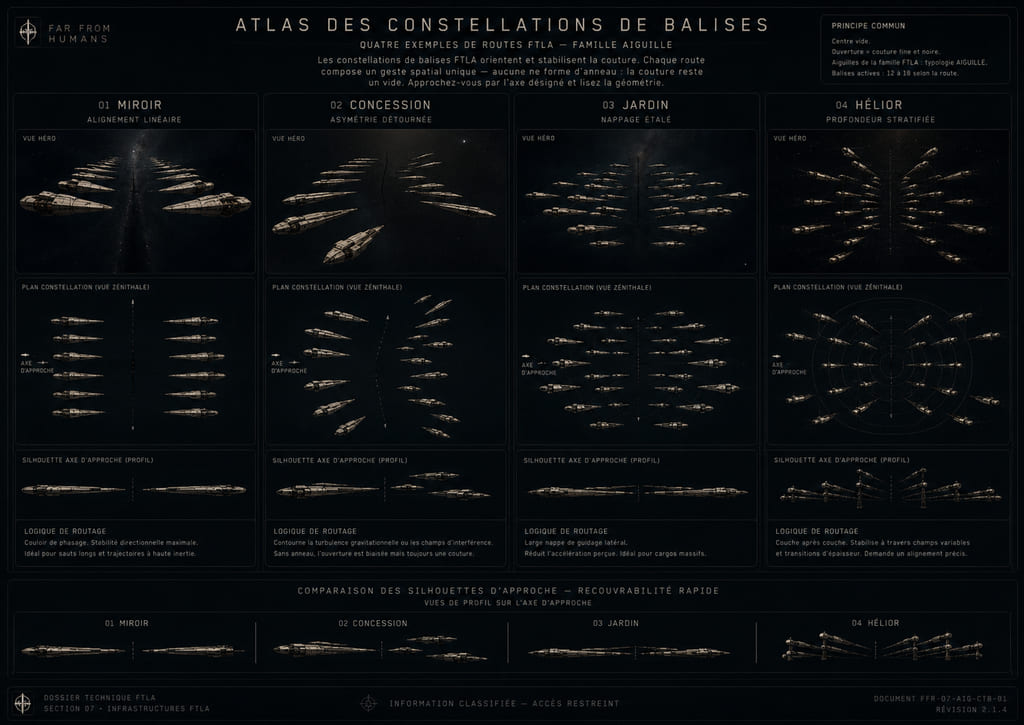
FTLA beacons measure, synchronise and stabilise a natural passage. Around an empty centre, their Needles form irregular constellations. Their geometry depends on the route they maintain.
At the centre, the passage is a three-dimensional black seam. You can also read it through what it takes away from the sky.
When a seam closes
Messages, transactions and news follow these same routes. A closed seam cuts off exchanges. Politics, memory and trust are affected at once.
The public Atlas will remain partial. Each place shown must have its function, history and cost.